Should Non-Profit Boards Be Paid?
Aug 2025
This is a topic worthy of consideration.
Firstly, some general facts we do know:-
NFP Directors have more complex roles than their for-profit counterparts:
Their focus on purpose or mission is far greater and more intertwined with impact beyond
financial outcomes
The complexity of governance is increasing for Boards and Board members with the
heightened attention on ESG
They often have multiple stakeholder groups to manage, not just shareholders & staff
On average, NFPs generate only 18% of revenue from commercial activities; therefore,
82% comes from other stakeholders
Their consumer (user) and customer (payer) can often be different, bringing multi-dimensions to marketing, acquisition and retention priorities, as well as critical success metrics
The overwhelming majority of Board members are not paid for their services
Time commitment is increasing, with the clear majority dedicating more than a day each month to NFP Board work, with 46% more than 3 days, and 20% more than 6 days.
I could stop here and say there is already ample justification to find and reward the best talent for non-profit boards. It’s hard work, getting harder and more specialised.
According to the AICD, the number 1 challenge for Boards post-COVID-19 was the diversification of income. That’s a specialised skill if ever there was one.
Here’s some more data courtesy of AICD’s NFP Survey:
50% of all NFP board members are unpaid
26% are unpaid but get expenses covered
22% are paid
81% of NFPs have not discussed the option of paying board members
Development & Housing (39%) & Health & Residential Aged care (35%) are the highest sectors likely to be paying Board members
Arts/Culture/Sports (6%) is among the lowest sectors paying Board members
Of those paying, the average salary is $22,581 per Board member.
Whilst payment is not the be-all and end-all of ensuring Board performance, we believe it should be seriously considered for many non-profit Boards. Board members are no less important than the executive team. They aren’t there to fill up numbers. They have a critical, indispensable role to play in the development and oversight of an organisation’s strategy.
And whilst the trend, both here and in the USA, is moving towards paying Board members, there is a mindset and culture to overcome (and yes, in some organisations, a constitutional barrier). Culturally, we still think Non-Profits are a training ground and/or that we can’t afford to pay Board members. Yes, volunteers have a huge and precious role to play in NFPs, but Board members are the ultimate and final people responsible and liable for the professional stewardship of an organisation. Our non-profit sector is not and should not be for learner drivers.
Go with me here for a bit. With Board rotations coming up every 2 or 3 years, there’s a constant demand for people to fill empty seats. The challenge is, those most likely to step up time and again are those passionate about, or connected to the cause – someone with lived experience of the cause impact or, in an Association, a member. But does that qualify them to bring the insights and experience to grow and or govern the business? I know it’s not always the case and some amazing Board Directors are doing equally amazing jobs for knicks, but every seat needs to be filled, and that’s a slog and a risk.
Is that what happens in the commercial space? I think not, for sure. The commercial space will pay for Board members because:
They want the best people
They want to dictate the diversity of skills, gender and culture they think they require to perform well
They want to be able to hold someone accountable.
Performance and accountability in non-profits matter just as much, arguably more. If you think you can’t afford to pay your Directors, ask yourself why you must pay your CEO.
Ultimately, compensating NFP Board members isn’t about diminishing the sector’s value or values —it’s about empowering it to achieve its mission with the best possible leadership.
Don't forget the people...
Nov 2025
Let’s face it, AI is the elephant in every work room now and will be for the foreseeable future.
In our experience, it is generating inertia and indecision across the resource-starved for-purpose sector.
Employers are uncertain about where and how to implement it—and how to manage the disruptions it
may create. Employees are unsure of process, procedures and approvals. Boards are working overtime
on governance and risk.
Yes, AI can be incredibly powerful and can save significant time and money. But none of that matters if
you lose sight of the people—or the purpose. Technology alone doesn’t create meaningful, impactful
growth. People do.
Which is why the fundamentals still matter: People. Alignment. Change.
How do you bring every tier of an organisation behind a simple, compelling plan to move forward? How do you keep your eye on the prize—the main game of making a bigger impact?
To support that journey, we’re excited to introduce our new offering: People, Alignment & Change, supporting growth in purpose-driven organisations.
This work is underpinned by internationally recognised people and change methodologies, including LSI, GSI and Prosci Change Management, complemented by certified business and individual coaching and culture measurement.
If you’d like to explore how to align your organisation behind a forward-looking growth plan, visit our services page and reach out for a chat.

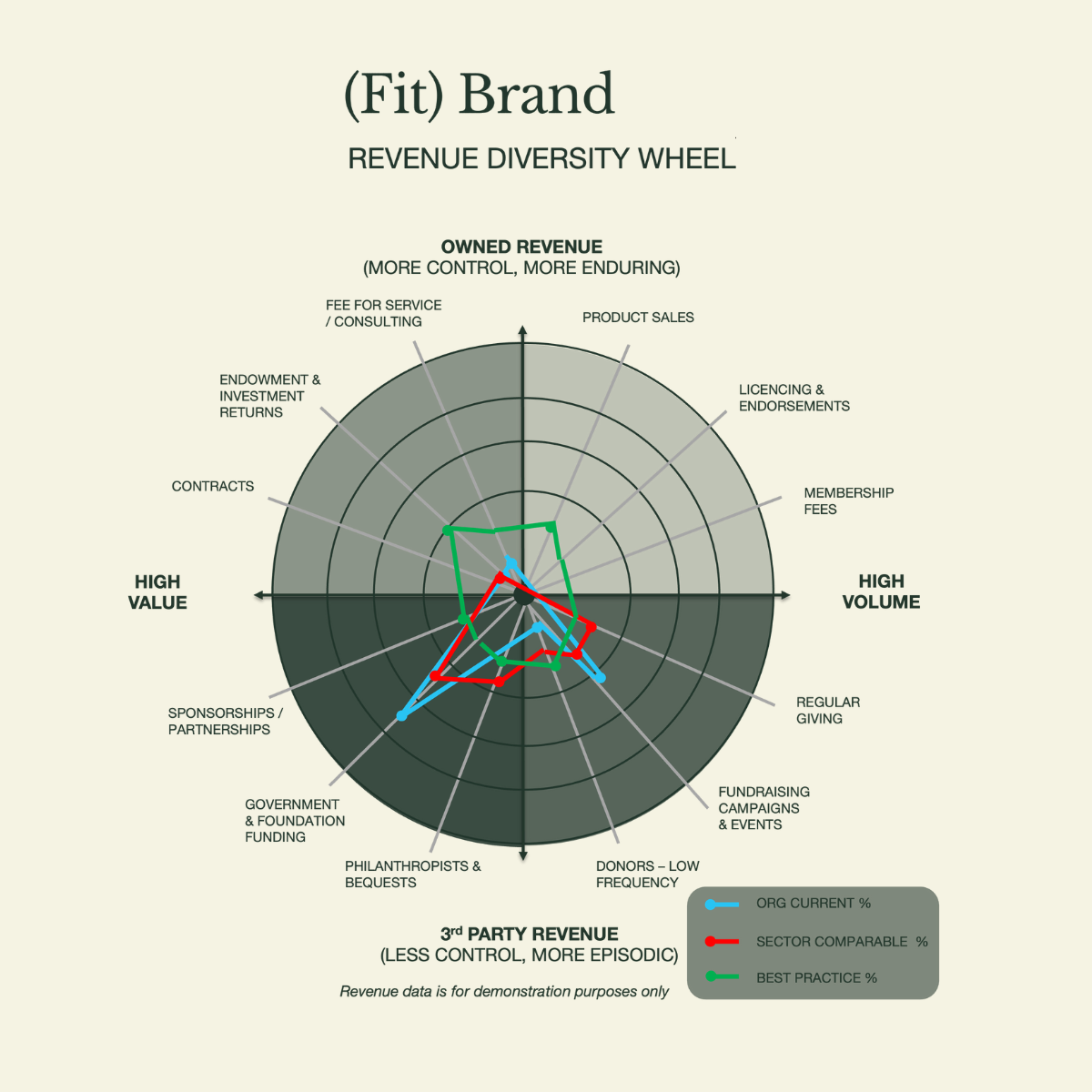
Revenue Diversity — Clarity for Non-Profits & For-Purpose Organisations.
Nov 2025
We’re excited to share our newest tool designed for CEOs and Boards who want a clear, immediate picture of their revenue mix and competitive positioning.
The Revenue Diversity Wheel gives leaders insight into where their income sits today, how it compares with sector norms, and where the opportunities for greater control and sustainability are.
Already, it’s helping clients benchmark their current position, identify vulnerabilities, and align their teams around a practical plan for diversified growth.
Building revenue diversity shouldn't be a mystery; it’s a process, and it’s open to every organisation ready to take the next step.
Breaking The Scarcity Mindset.
Jan 2025
Have you ever thought about the unfair constraints we impose on non-profits,
the uneven playing field compared to the commercial sector? It’s a conversation worth having.
For decades, we’ve burdened non-profits with a scarcity mindset—a framework that prioritises
frugality and minimalism at the expense of growth, innovation, and impact.
The Scarcity Trap
Unlike for-profit businesses, which are encouraged to take risks, invest in innovation, and reward talent,
non-profits operate under restrictive expectations. Consider these prevalent attitudes:
Frugality as a Virtue: Society values frugality in charities, often mistaking low spending as a measure of effectiveness.
Overhead Obsession: We hyper-focus on overhead costs, using them as an unfair proxy for performance while ignoring the broader impact achieved.
Cost Fixation: The emphasis on cost control overshadows discussions about revenue generation and long-term sustainability.
Dollar Efficiency over Impact: We scrutinise how every dollar is spent rather than assessing the overall volume and magnitude of results delivered.
Risk Aversion: Non-profits are discouraged from taking risks, even when the potential for high-impact outcomes exists.
Disconnect from Market Performance: Non-profits are rarely evaluated with the same competitive and market-based metrics that drive success in the commercial sector.
Talent Undervaluation: High-performing executives in the non-profit world are penalised for earning competitive salaries, and we balk at compensating board members despite the need for top-tier talent.
A Double Standard
Why do we treat the impact sector—arguably the most crucial one to get right—as a proving ground for talent or a pipeline to feed the for-profit domain? This mindset creates systemic inertia, where organisations struggle to move forward due to insufficient funding. In the commercial sector, lack of funding rarely halts progress. Companies find alternatives—whether through monetising their strengths, securing investment, or innovating their way out of challenges.
When non-profits attempt bold initiatives and fail, the narrative shifts to one of waste: “They squandered our money.” Meanwhile, for-profits can allocate billions to R&D, with failure regarded as part of the innovation process—an “investment” consumers ultimately pay for.
The Role of Media and Government
This scarcity mindset is perpetuated by governments and amplified by the media. Non-profits are held to a different set of rules, which often leads to stagnation. Overhead becomes the villain, while impact—the very reason for the organisation’s existence—takes a backseat. This dynamic acts as a brake on growth and prevents organisations from reaching their full potential.
A Call for Change
Dan Pallotta's documentary, Uncharitable, highlights these issues brilliantly. His argument focuses on the obsession with overheads and how prioritising cost-efficiency over impact is counterproductive. It should be required viewing for non-profit CEOs and board members.
However, the scarcity mindset runs deeper than overheads. It permeates non-profits’ cultures, strategies, and day-to-day operations. In our decades of working with the impact sector, we’ve observed this mindset—and its consequences—up close.
Towards a Balanced Approach
While some NFP organisations lean too far into commercial practices and risk losing the intangible value and trust that underpin many non-profits, the majority are still shackled by scarcity thinking. The balance lies in empowering non-profits to:
Invest in Growth: Encourage risk-taking and innovation to achieve meaningful, scalable impact.
Reward Talent: Pay competitive salaries and attract the best leaders and board members.
Think Commercially: Shift energy away from “asking” for funds to “earning” revenue through sustainable models.
Measure Impact, Not Overheads: Evaluate success based on outcomes and long-term change, not arbitrary financial ratios.
Conclusion
If we want the impact sector to thrive, we need to dismantle the scarcity mindset and replace it with a more expansive, commercial way of thinking. Non-profits should be free to innovate, grow, and attract top talent without fear of criticism. By shifting our collective expectations, we can create a thriving impact sector that generates profound, lasting change.

Why Non-Profit CEOs Should Be Wary of Corporate Sponsorship
Aug 2024
It’s every Not-For-Profit CEO’s dream… to snag a 6-figure sponsor. But here’s 3 reasons why they should be wary of it:
It’s elusive
It’s distracting
It’s unscalable
Perhaps a somewhat ‘interesting’ view coming from an organisation that led the non-sports sector in brokering sponsorships for 2 decades. But it is our very firm, experienced view.
So firstly, it’s elusive. The long corporate planning cycles, the various financial year windows in which to approach corporates, the poor remuneration for NFP sponsorship Managers, the high staff turnover and therefore the lack of experience in the sector (largely blame tier 1 sport), plus the difficulty in fashioning an ROI for sponsors makes meaningful sponsorship highly elusive.
Next, it’s distracting. NFPs generally don’t have the bandwidth to dedicate resources to non-core activities. The ROI demands of corporate sponsors can often be resource-depleting and counter-productive to BAU activities. Moreover, it is often much more difficult to integrate a sponsor than, say, in most major sporting codes. There are all sorts of hurdles to overcome: brand fit and integrity, audience alignment, activity appropriateness, corporate behaviour, audience perceptions, and so on.
But the big one for us is the lack of scalability to corporate sponsorship. Unless you have an existing platform, such as a conference, expo, or the like, every sponsorship you negotiate will be unique. So, you have to invest heavily in the early days to build something bespoke to address each and every sponsor’s individual challenge, and just when you start getting it right, you are up for renewal, likely with a whole new set of demands that you may or may not be able to meet.
Some NFP’s break the mould, generally the big brands that are largely rewarded for their brand health and the halo it brings for corporates. But for the very many that aren’t number 1 in their category, the golden rule is: It must directly enable your core business—help build your brand, acquire new audiences, and scale your core products and services.
So, if you do pursue corporate sponsorship, do it with eyes wide open, be focused on your human resource allocation and priorities, selective in who you court, and single-minded in what determines a ‘good fit’. It’s also not such a bad thing to stick to your core BAU knitting and just look for ways to grow it with greater scale.